


Remember even the Painful Past
By Bruce Baker
Much of history is tragic, and Cherokee County is no exception. I’ve encountered stories about the victims of train derailments, bridge collapses, fires, and tornadoes, and shared them with readers.I do so because we honor the victims when we remember and retell their stories.The renowned theologian Lewis B. Smedes wrote the following in Forgive & Forget: Healing the Hurts We Don’t Deserve: “Forgiving does not erase the bitter past.A healed memory is not a deleted memory.Instead, forgiving what we cannot forget creates a new way to remember.We change the memory of our past into a hope for our future.”
Many are familiar with the tragic events of October 1912 in neighboring Forsyth County. When three young Black men were convicted of raping a White woman, the violence that erupted thereafter resulted in all 1,098 Black residents being expelled from Forsyth County. That story made national headlines at the time, and it has been told and retold dozens of times. What is rarely reported, however, is that this antipathy spilled over into Cherokee County also. While the scale was much smaller, the expulsions of Blacks in Cherokee County deserves a place in our collective memory.
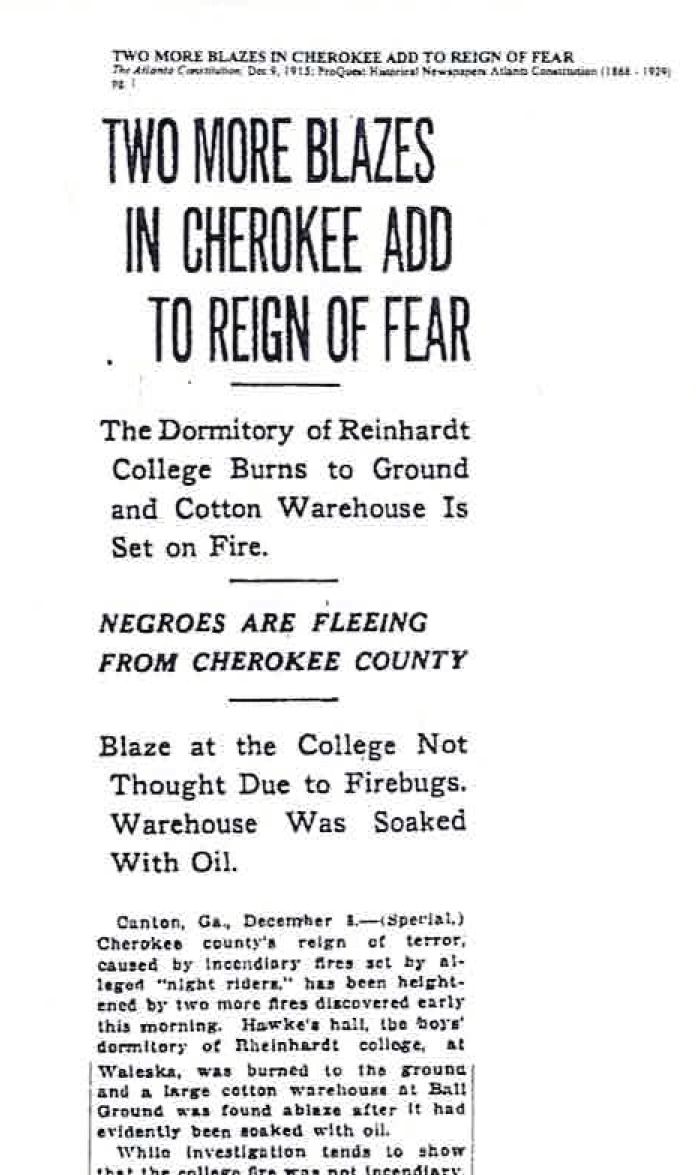
The April 15, 1915 issue of the Atlanta Constitution ran an article headlined “Two More Blazes in Cherokee County Add to Reign of Fear,” with the byline “Negroes Are Fleeing from Cherokee County.” It tells the story of a large cotton warehouse in Ball Ground that had been soaked in oil and set ablaze by the “night riders,” and says it was the ninth such fire in three days. It’s worth noting that these events weren’t broadly supported by the locals. The article mentions that the state fire inspector had found clues that were helping local officials bring the firebugs to justice, and that private detectives had been brought in to provide additional support.
The trouble was predictably most prominent along the Eastern Cherokee County border with Forsyth County; the article states that White farmers within eight miles of the border that employed Black farmhands had their barns burned, and the hands themselves left the area for fear that even worse could happen to them. But it wasn’t confined to that part of the County. As one example, a Sheriff Pinnear in Waleska had earlier spent three months in the woods near town, eventually capturing eleven clan members that were conducting a similar reign of terror there. The eleven men were tried and convicted, with some getting fifteen-to-twenty-year sentences, and two members receiving life sentences. Some died in prison; others were pardoned after several years.

Expulsions from Ball Ground also took place, and I am indebted to Dr. Kenneth Wheeler of Reinhart University, and two of his students, Courtney Holcombe and Steven Karafa, for having combed property deeds, census records, newspaper articles and other historical accounts. They summarized their work in a May 2013 paper. A thriving Black community in Ball Ground had begun in 1898 with the purchase of land by Samuel E. King, an African American blacksmith. But from 1912 through 1920, they were systematically targeted for expulsion. The 1910 US Census has 142 Blacks and mulattos in the Ball Ground District; by 1920, that number had dropped to 66. Mr. King has the distinction of being the only African American to appear in the 1900, 1910, and 1920 US Census. The first burial in the Black section of the Ball Ground Community Cemetery has a headstone dated 1899; the last one is dated 1918. Between 1912 and 1920, Cicero Allen, George Strickland, Liza Lynch, and Joseph Jordan all sold their property in Ball Ground and left. And on March 26, 1920, even Samuel E. King, the founder of that Black community, sold the first of his properties. By the end of 1920 property records indicate that all land that had previously been owned by African Americans had been sold.
There are firsthand accounts as well. Floyd and Charles Watkins quoted the account of Cyrus Homer, which I’ll summarize here. Homer says there were once more Blacks than Whites in Ball Ground, but that “a few sorry, low-down White folks” ran them out of town to take their jobs. He says a few homes were dynamited to make clear that they had to leave. Other reports suggest that many of them moved three miles north, to merge with an existing Black community in Nelson, Georgia.
To be clear, this behavior wasn’t limited to this area, this state, or the South. I am from the Midwestern US, and very similar events took place there during the early 1900s. While a great many of us wish it wasn’t so, these expulsions aren’t just Southern History… this is American History.
These events happened over 100 years ago. The most recent Census Data shows over two dozen Black Americans living in Ball Ground, and Blacks make up 6.5 % of all Cherokee County residents. Clearly, as a County we are in a much different place today. But just as every chapter in your life and mine is significant, every chapter in Cherokee County history is significant. We should always keep moving forward, but we must also occasionally look back, because learning from our past is the only pathway to a hopeful future.
Read the entire AJC article from December 9, 1915.