



A Fish Story that Rings a Bell
By Bruce Baker
Rail accidents are not as rare as you might think. In March, I wrote about the failure of a trestle spanning the Etowah River on the Amicalola line, which ferried marble from the quarries into Ball Ground. Only twenty years later, another train wreck would send a locomotive plunging into the Etowah River. And this time, the tale wasn’t fully told until almost 80 years later.
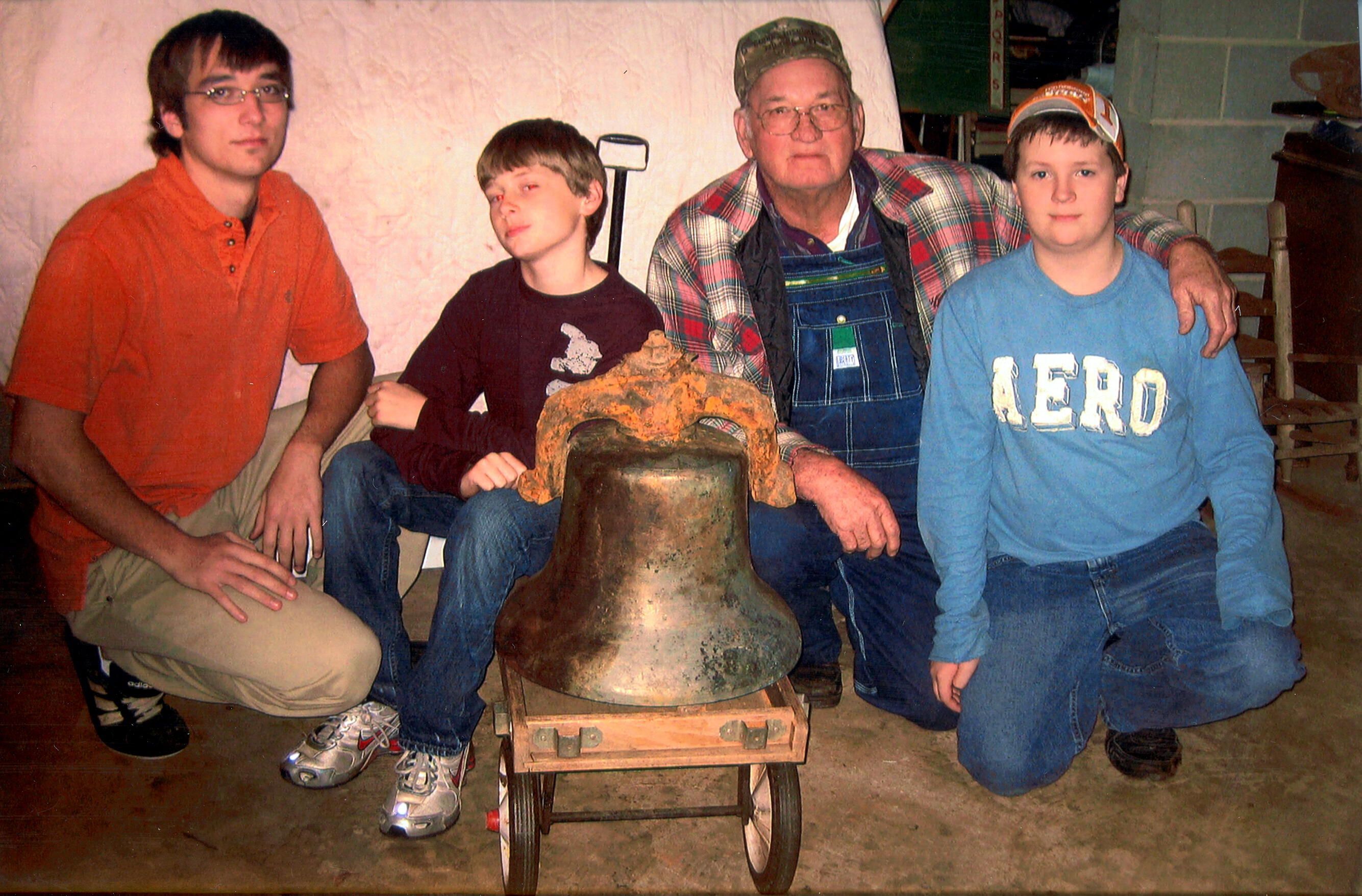
In the Fall of 2008, Lowell Manous took his grandkids fishing on the Etowah River, just north of Canton but not quite to Keithsburg, along a stretch where the river curves back and forth several times. The river was as low as he’d ever seen it, and he’d fished this part of the river for most of his life. But on this day, he’d catch more than fish: he’d catch a piece of history. Lowell noticed something large and metallic by the water’s edge, at a place where it would normally be below the water level. Upon examination, it was a large metal bell. He took it home and cleaned it off; the clapper was rusted and wouldn’t move, but the bell itself was in very good condition. Lowell had fished this section of the river with his father-in-law many times, and he remembered him telling him of a train wreck that occurred very near this spot many years ago; he immediately suspected that this heavy bell might be connected to that accident. He was correct, and the tragic tale of the “Little Hook” is a piece of history that deserves to be remembered.

On July 15, 1926, the Number Four train on the Louisville & Nashville Railroad, it’s engine nicknamed “Little Hook,” pulled into Canton a few minutes late of its scheduled 9:10am arrival time. It had left Atlanta at 7 a.m., and its final destination was Knoxville, Tennessee. Behind the engine was the coal car, then a baggage and mail car, and two passenger cars. It left the Canton Station with Engineer Buck DeArmond at his post on the engine, along with Fireman W. E. Wiley at the coal car, and Mail Clerk J. T. Coker in the baggage car. A couple dozen passengers were on board in the final two railcars.
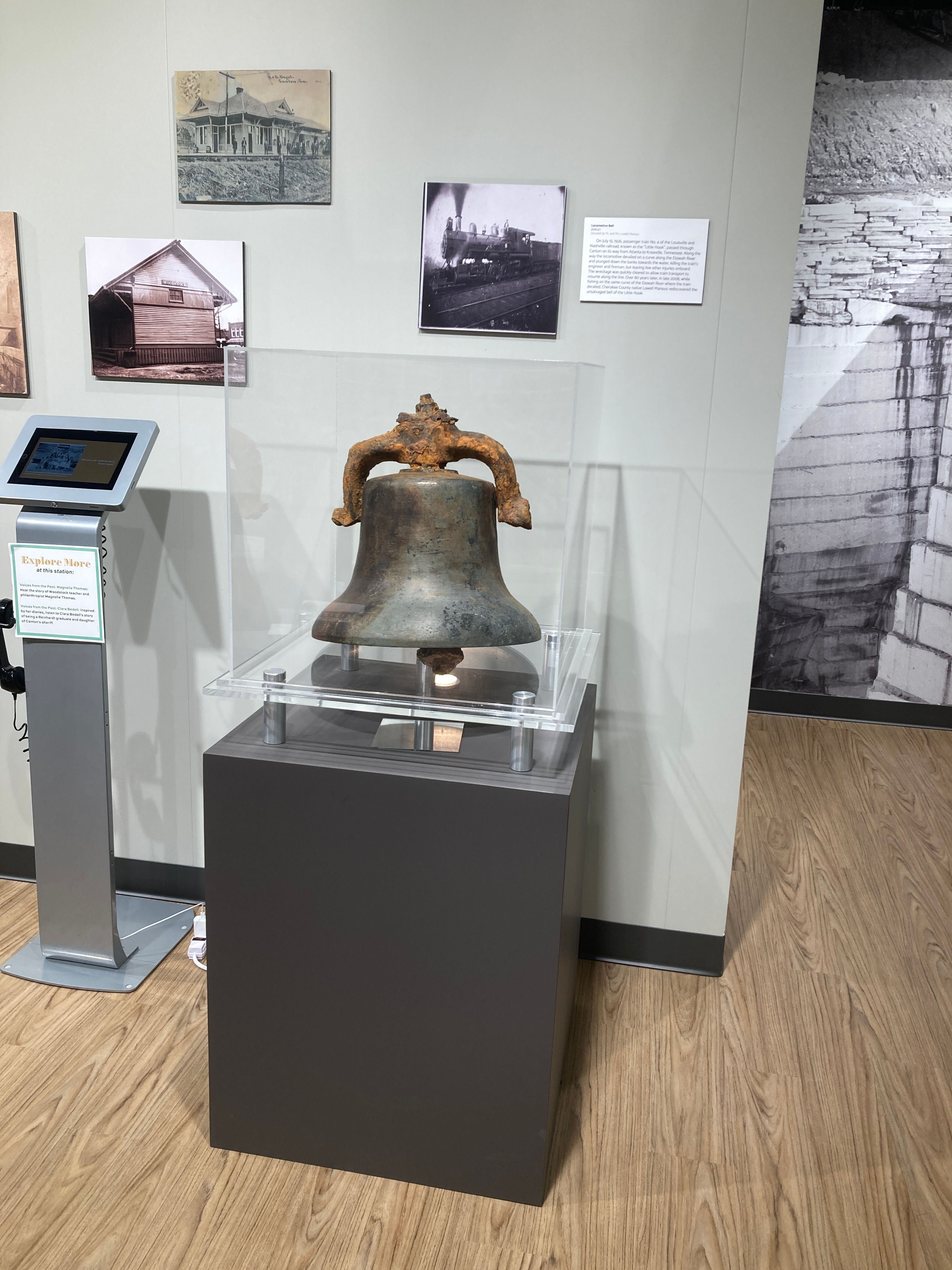
Upon leaving Canton, the train was anxious to make up time, and one theory holds that they took a curve too fast in their haste. Another explanation given was that on the fateful curve, one of the engine wheels broke. What is known is that four miles outside of Canton, on a sharp curve in the track alongside a steep embankment beside the Etowah River, at right around 10am, the engine derailed, and plunged 50 feet down, rolling over at least twice before coming to rest on the bank right beside the river. The coal car and baggage car followed it down, with the mail and baggage car coming to rest on top of the locomotive. The coal tender came to rest in the river. Miraculously, the rail couplings linking the passenger cars had snapped, and as a result they remained on the tracks. All the passengers were unhurt, and many of them rushed down the hillside past the three large trees that had been downed to see if they could aid any of the railroad crew. DeArmond was found at his post, his hand near the throttle, dead. Wylie was located under the wreckage, where his body could not be recovered until the wreckage was removed. The mail clerk miraculously escaped in good shape, with only minor cuts and bruises. Cranes were eventually brought in and the wreckage brought back up and hauled away… all except for the bell from the locomotive, which was evidently dislodged from the car and flung into the river, where 82 years later, it was found by a grandfather fishing with his kids. You can actually see this artifact of history firsthand, as it’s currently on display at the History Cherokee County History Center.