




Foxfire:The Fine Art of Self-Sufficiency
By Bruce Baker
In 1966, an English teacher named Eliot Wigginton at the Rabun Gap Nacoochie School in Northeast Georgia engaged his students in a writing assignment that involved interviewing elders to document the local culture and traditions of Appalachian life. It quickly grew from a quarterly magazine issued by the school, until in 1972 Random House published the first of what would become a dozen volumes. Named Foxfire after a bioluminescent lichen found in the area, the book became a sensation, and over nine million copies of the various Foxfire books in the series have been sold, the bulk of which were written between 1972 and 1986.They teach every aspect of culture, demonstrating in the process how people learned to do everything for themselves. The give instruction on how to make quilts, home remedies, pottery, gourd banjos, shoes, moonshine, log cabins, or butter churns. They teach skills as varied as fence mending, wagon making, blacksmithing, crop planting, midwifing, game hunting, and faith healing. They contain local folklore, ghost stories, faith traditions, and family histories. Told firsthand by the seniors who have practiced what they teach for their entire lives, in highly colorful local dialects, they are as entertaining as they are instructional. If you have not been introduced to these before now, you should make it a point to head to your local library and check one out. Once started, they are hard to put down.
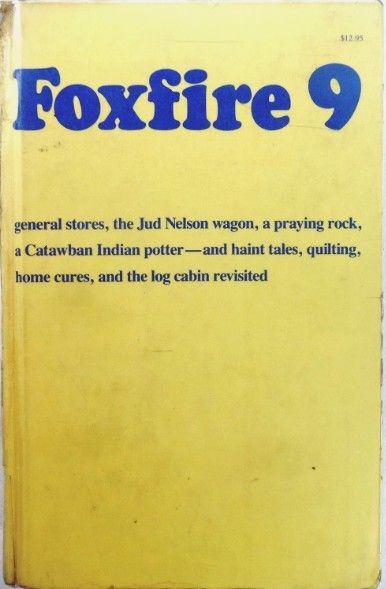
I took a quick look through the series recently just to see if I could locate a Cherokee County reference to include as an example of what you’ll find in them. A little more than halfway through the Foxfire 9 volume, I found one. It’s an interview with Jud Nelson, a local blacksmith, who relates his family history while teaching a student, David Brewin, how to make a wagon. David includes 160 photos, outlining step by step from conception to completion over three months. What follows is Jud’s recollection of his Uncle John Nelson, who spent most of his life just outside of Canton, GA.

“I was born in Cherokee County [Georgia], and moved to Gordon County in 1913 when I was two. I’ve lived in this county ever since then except for about four years [when I was in the Navy].
Daddy had three brothers.My Uncle John Nelson, Daddy’s oldest brother, was a blacksmith. He had a shop down below Canton.I never did remember seeing him—he seen me when I was little—but they said he was six foot six inches tall and was a real character.
I’ve heard a lot of them say that he was a fiddle player from a way ago.Dad said he knowed of them a-sittin’ down at night there—start about eleven o’clock—and he’d still be playin’ when the sun come up and never play the same tune over. He’d drag that bow! I think he was pretty full of mischief, too. Mean as the devil. Said that some old feller down there—didn’t know him—kept on him to come out to [his house] and bring his fiddle with him one winter night and stay till bedtime. Uncle John went out there about eleven o’clock, and that was late then, and he got his fiddle out and started playing and he was still playing when the sun come up the next morning. That old man never did say no more to him about the fiddle playing after that. He had all he wanted!
But he was a real Francis Whiitaker [one of the finest blacksmiths in the country] in his days from what they tell me. Him and the other man is all I ever knew that could weld a main leaf for a car spring and upset it and retemper it, so he had to be pretty damn good on it, I think. I haven’t tried welding a spring in thirty years. Used to, I’d just try it and think I had it and then it would fall in two. I didn’t do no good!
And I heard a lot of folks say that years ago, gun springs would break, and a lot of other blacksmiths could make [them] but they could temper [them correctly]. And I’ve heard a lot of them tell me that there’d be blacksmiths ride a horse ten or fifteen miles to get Uncle John to temper a spring for them. They’d make it and get it dressed good and then take it to Uncle John. My daddy said he would harden it, and then he used beef tallow, and he’d draw that temper with that beef tallow once it got dry.
Lots of people would try to get him to teach them. My cousin told me once that years ago a blacksmith started out and he went down and told Uncle John that he wanted him to teach him how to forge-weld. Uncle John went down there and the feller had some [corn] liquor sitting there and they got to sucking along on that. Said that the old boy got pretty high. He was still pumping that bellows and had [a piece] in the fire ready to weld. Uncle John didn’t say a word to him and that boy took it out and he’d done burned it up. Uncle John said, ‘Well,’ says, ‘that’s the best lesson you’ll ever learn.' Says, ‘You’ve got to pay attention to what you’re doing.’ Got on his horse and went back home.”
“But anyway, later in his life Uncle John went down to Plains, Georgia, and put up a blacksmith shop and wagon manufacture there in 1922. He got damp out there building the shop—took pneumonia—and died in about two days. He was fifty-two or fifty-four.”
There is much you can learn from these books, but I think the most important lesson you learn is that you learn to respect these simple people. Their ability to take care of themselves as just the ordinary course of their lives runs well beyond what any “survivalist” TV show does today. And if along the way, you also learn what a hoop snake or a monkey wrench quilt is, well, so much the better.
Check your local library for the Foxfire books. You can also learn more at the Foxfire Village Museum and Mercantile in Mountain City, GA.