



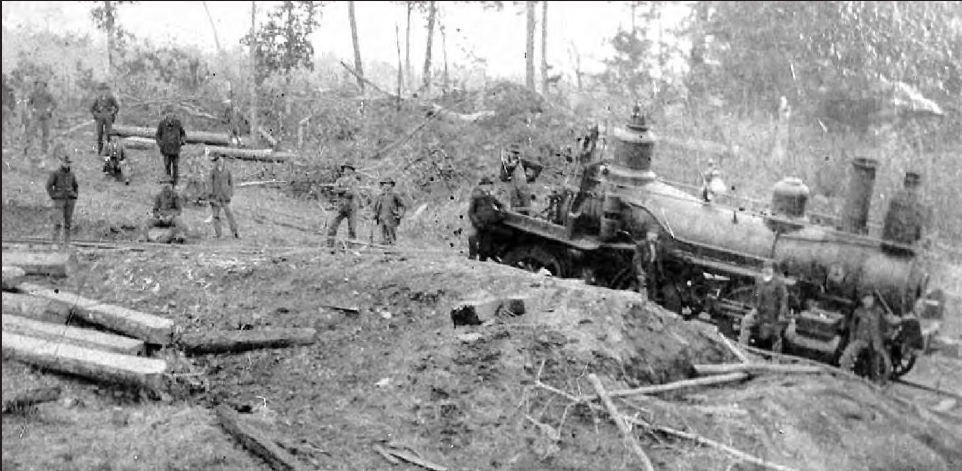
Wreck on the Amicalola
by Bruce Baker
November 4, 1904 was a beautiful fall Friday in Cherokee County. On that morning a 60-ton steam locomotive wound its way north from Ball Ground, GA some ten miles to the Herndon Quarry just south of Marble Hill, GA, along a standard gauge rail line, crossing the line from Cherokee County into Pickens County along the way. This short stretch of track was known as the Amicalola Marble and Power Railroad, as its owners had dreams of extending it up as far as the famed waterfall and using it to generate hydroelectric power. This was a daily run; the locomotive pulled two flatcars. These would be loaded with large blocks of Georgia Marble for the return trip to the finishing plant for the Atlanta Marble Company, located on Main Street in Ball Ground, near the main rail line, which at the time was called the Atlanta, Knoxville, and Northern Railroad. Soon it would become known as the L&N Railroad, and it would be used to carry finished marble pieces to Atlanta, and beyond. The marble on this day was ultimately headed for St. Paul, Minnesota, for use in the construction of the new State Capitol.

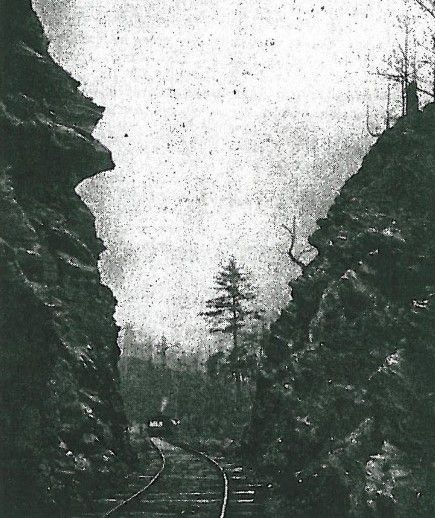
The rail line went through deep woodland with tall timber, some steep terrain, and passed over the gorge that held Fourmile Creek by crossing a series of well-built wooden trestles. The tallest of these was some 70 feet in height, crossing over Reavis Road; farther up, a second trestle measured some 47 feet high, and crossed Fourmile Creek on the bank opposite Freeman’s Mill.There was one final trestle after this one, then the land flattened out and the path became much straighter. By midday on the fourth, they had reached the quarry, where a steam derrick loaded the blocks onto the flatcars.
They began the return journey. Eight men were aboard for the southbound run, including James Polk Harrison, a part owner and General Manager of the Atlanta Marble Company. Rail line Supervisor A. C. “Arch” Gaddis was also aboard; the operating crew included engineer Owens, and fireman Henry Ingram. Y. J. Thomason, Bud Howard, along with two black workmen named Pete and Pat Jordon made up the rest of the crew. Ingram, Owens, and Harrison were in the engine cab; the rest were spread throughout the train.
Archie Gaddis had worked as a supervisor on the Atlanta, Knoxville and Northern, and had accepted the position of Road Master on Harrison’s 10-mile railroad only months before. Traffic on the quarry line had increased significantly because business was booming; this demanded a man of his experience to oversee the maintenance and recommend upgrades both to the track itself and the equipment that operated on it.
Henry Ingram fed log after log into the firebox, maintaining a steady speed driven by the boiler on the steam engine. As they approached each trestle, Engineer Owens would pull on the whistle cord, sending a shriek in advance to warn anyone walking on the trestle to get out of the way.
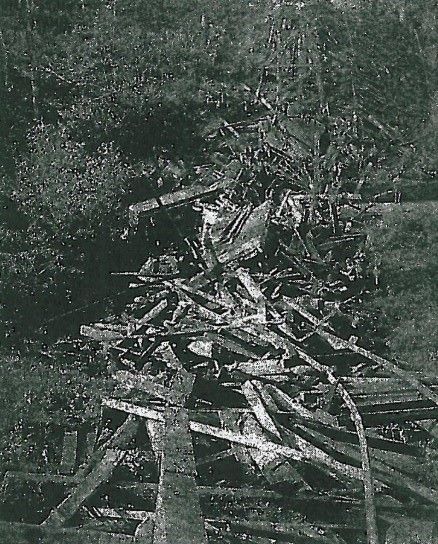
It was as the train crossed the trestle across from Freeman’s Mill that disaster struck. An odd, deep groan was heard from below, followed by the split of a piling with a crack that resembled a rifle shot. The splintering continued, multiplying, and the bridge started to quiver. The rails themselves began to screech, and near the center of the trestle the track began to sag. And then, 200 feet of timber and steel collapsed, and the train dropped 47 feet into the hollow below.
Everything fell: the trestle itself, engine, tender, flatcars, marble, and men. At first the noise was deafening, but it faded into silence, only to be replaced by the yells of men from the mill, running to the wreck site. Gaddis, the road master, was dead, as was Harrison, the General Manager. Engineer Owens was injured badly; Y. J. Thomason was scalded by steam around his face.Ingram had broken his back; he was fortunate not to become paralyzed, but his long and painful recovery resulted in a morphine addiction, which he would only overcome years later with the assistance Rose Cochran, whom he married on Christmas Day in 1906.
The other men aboard that day escaped with only minor injuries. The trestle itself would be rebuilt, and tons more marble would be carried along the Amicalola Railroad. In fact, the marble blocks used to construct the statue of Abraham Lincoln in the Lincoln Memorial would travel this very route, with the statue itself being completed at the beginning of 1920.

As I mentioned, the Amicalola Railroad was only ten miles long. Once the marble blocks were ready to ship out of the finishing plant, and leave Ball Ground, they would then be loaded onto railcars on the main line, which by now was known as the Louisville and Nashville Railroad, or L&N. For example, the finished marble blocks destined for Lincoln’s statue were delivered to a studio in the Bronx, NY.
Twenty years later and only twenty miles away, another railroad accident would claim lives, this time on the main line, the L&N Railroad (Louisville & Nashville), in 1926… but that is another story, best left for another day.
The images used with this story are from an newspaper article in the Pickens Progress on August 14, 2008 recounting the train wreck. The images for the article were acquired from the Georgia Division of Archives & History. The Amicalola Marble and Power Co. engine at the top of the article is a different engine than the one that wrecked.